Products

Model:
HD-TA1L
Introduction:
Texture Analyzer (Multi-function Texture Analyzer) measures the mechanical response of solid and semi-solid samples under compression, puncture, shear and tension, calculating hardness, elasticity, cohesiveness and chewiness. Used for food, pharmaceutical and cosmetic R&D and quality control....
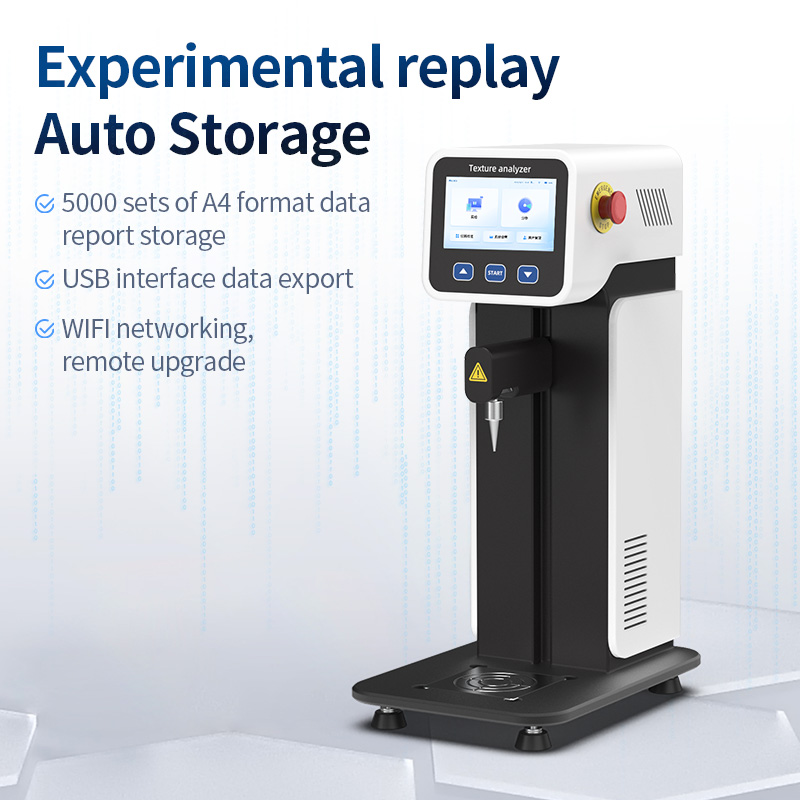
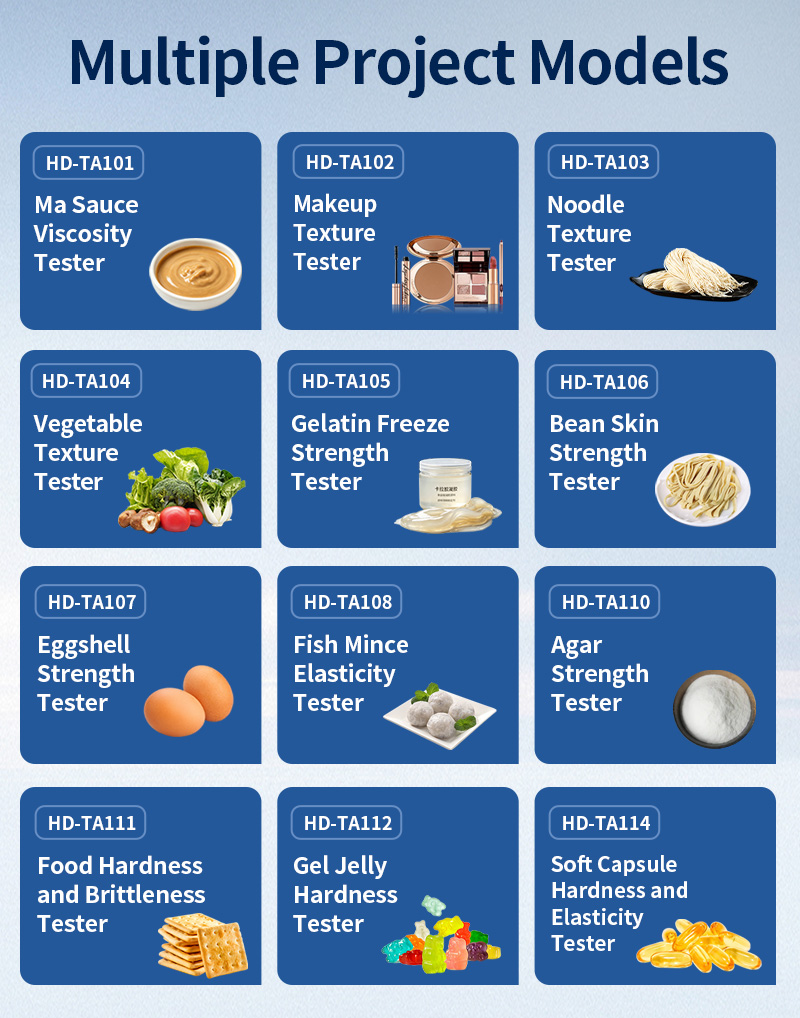
The Texture Analyzer (also known as a physical property tester) is used to measure the mechanical response of solid and semi-solid samples under loads such as compression, puncture, shear and tension, and to calculate texture indicators such as hardness, springiness, cohesiveness, gumminess and chewiness. The test results can be used for formula screening, process comparison, quality control and stability evaluation of foods, pharmaceuticals and cosmetics.
1. National Food Safety Standard — Food Additive: Gelatin, GB 6783-2013;
2. National Food Safety Standard — Food Additive: Curdlan, GB 28304-2012;
3. Frozen Surimi, GB/T 36187-2024;
4. Edible Gelatin, QB/T 4087-2010;
5. Determination of Meat Tenderness — Shear Force Method, NY/T 1180-2006;
6. AACC International Method 74-09 (bread hardness testing);
7. Testing of pharmaceuticals, cosmetics and materials shall be carried out in accordance with the applicable current standards or validated enterprise methods;
8. Note: The applicability of standards and the method version should be confirmed in combination with the sample, probe, range and software algorithm.
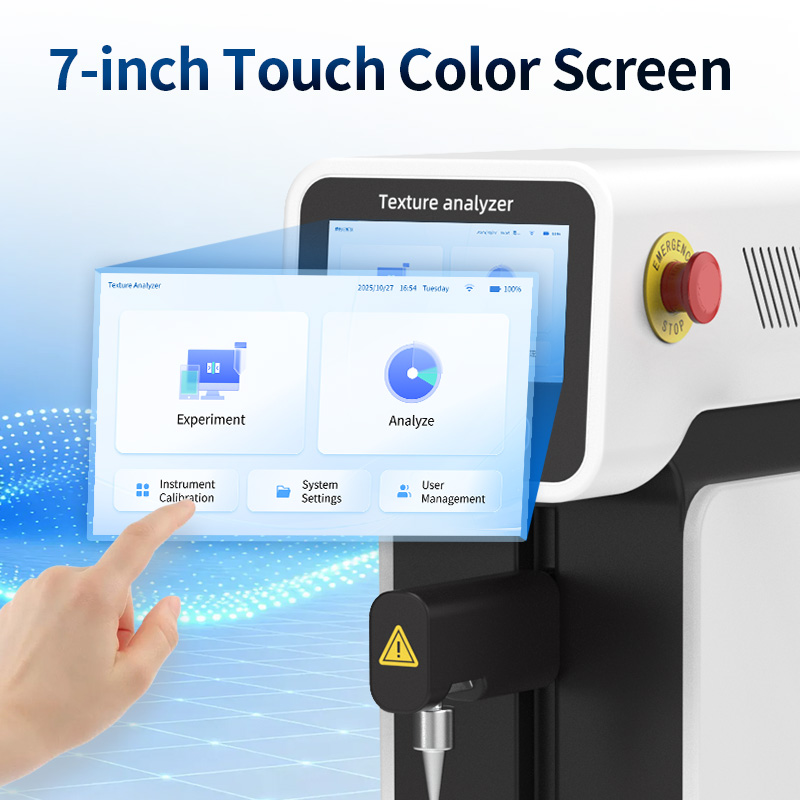
3.1. Human-machine interaction: 7-inch HD touch screen with Chinese-English interface switching; parameter setting and test operation are intuitive and convenient.
3.2. High-precision measurement: an industrial-grade analog-to-digital converter and a customized force sensor are used to achieve stable acquisition of force signals; the specific performance is subject to the configured range and the product specification.
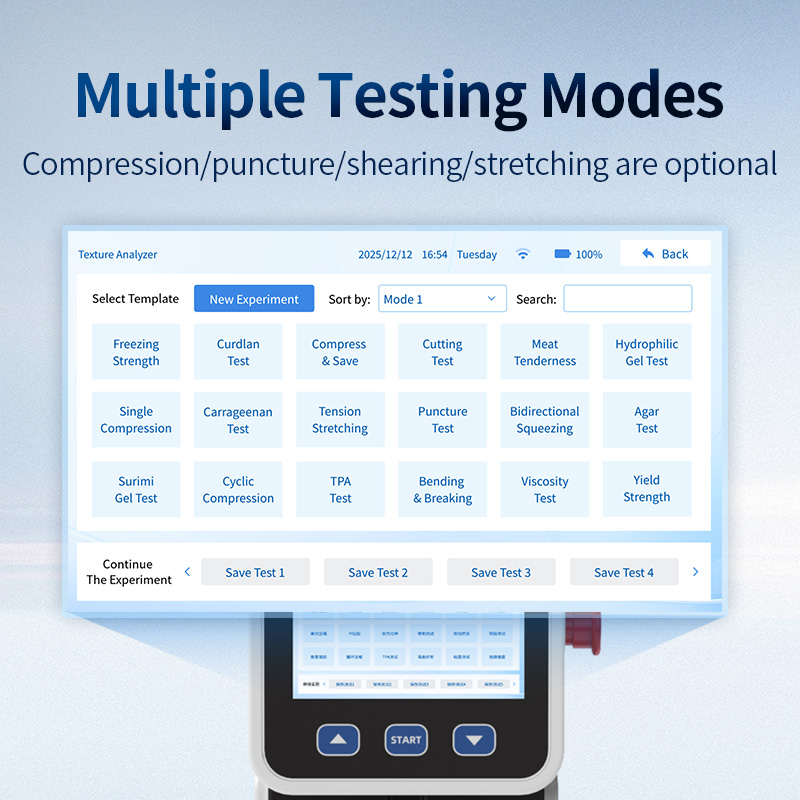
3.3. Test modes: built-in test modes such as compression, puncture, shear and tension, and support for building custom test items according to sample characteristics and evaluation objectives.
3.4. Test functions (partial): 1. Gel strength test: peak gel strength, area work (toughness); 2. Carrageenan test: breaking force, breaking distance, gel strength, brittleness; 3. Curdlan test: positive peak, negative peak, gel strength, brittleness, adhesion response; 4. Surimi gel test: breaking force, breaking distance, gel strength (force × distance); 5. Agar strength test: supports cylindrical probes of specified dimensions and method parameters; 6. Single compression test: peak force, deformation, area work, hardness, recovery force, etc.; 7. TPA full texture test: hardness, springiness, cohesiveness, gumminess, chewiness, resilience, etc.; 8. Bending test; 9. Shear test; 10. Puncture test; 11. Tensile test; 12. Adhesion test; 13. Spreadability test; 14. Yield strength test; 15. Stress relaxation test; 16. Creep performance test; 17. Custom test mode.
3.5. Motion architecture: closed-loop motor drive and double-row linear guide rail slide table with a nominal displacement index of 0.001 mm; equipped with stroke limit and force sensor overload protection.
3.6. Data storage: the main unit can store up to about 5,000 test reports with curves and supports export via a USB interface, facilitating on-site report output and experimental data archiving.
3.7. ★ One-key calibration function: provides a quick calibration function for daily calibration and verification; metrological traceability shall still be carried out using qualified standard instruments and records kept in accordance with quality system requirements.
3.8. ★ GMP management system: provides user permission grading and operation traceability functions for GMP management scenarios; regulatory compliance depends on the delivered configuration, system validation and user management procedures.
3.9. ★ Wi-Fi connection function: when the Wi-Fi function is configured, remote OTA upgrade and maintenance can be supported; actual use should comply with the user's network and information security policies.
3.10. ★ Physical keys: the main unit is provided with physical lift keys, which can control the probe to move up and down during sample loading and position adjustment.
3.11. Multiple standard probes: the standard probes are subject to the packing list; a variety of probes of different specifications are optional, and customization and quick replacement according to sample and test method are supported.
3.12. ★ Height calibration: height calibration limits the extreme stroke of the probe. It avoids incorrect parameter settings that would cause the probe to over-press and directly hit the sample table.
3.13. ★ Instrument protection function: emergency stop, upper and lower limit protection, and overload protection of the force sensing unit.
3.14. ★ Probe library supported on both PC and touch screen: probe name, length and cross-sectional area can be entered; a probe already associated with historical tests cannot be deleted directly, avoiding the invalidation of historical data due to missing probe information.
3.15. ★ Sensor replacement: sensors of different ranges can be switched quickly without dismantling the whole machine or using complex calibration fixtures.
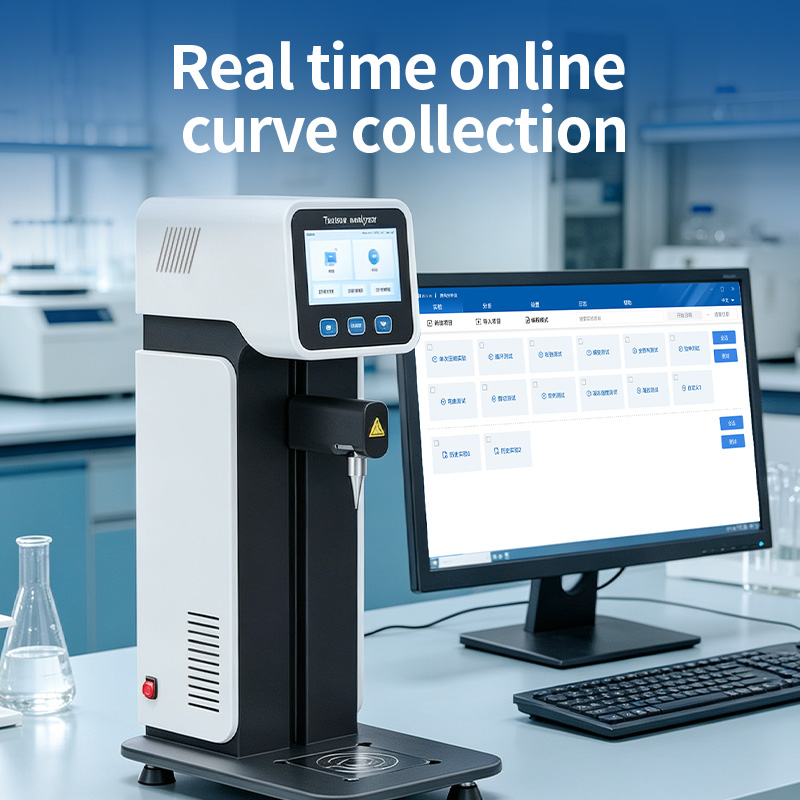
4.1. ★ Real-time characteristic curve display: supports 4 coordinate forms — time-load, time-deformation, deformation-load and strain-stress — and provides zoom, characteristic point marking, single point marking and curve display settings.
4.2. ★ Experiment and video playback: the software records the test process and can perform data restoration, curve redrawing and synchronous playback of operation videos for historical tests, and supports view-frame zoom-in and panning to facilitate analysis of sample deformation and mechanical response.
4.3. ★ Multi-curve comparison: up to 5 sets of current or historical test results can be selected simultaneously for curve overlay, comparison and analysis.
4.4. Synchronous recording with USB camera: the PC software supports an external USB camera to synchronously record test videos and align the video timeline with the test curve, facilitating correlation between sample deformation and mechanical response.
4.5. ★ Built-in formula editor: supports user-defined texture indicator calculation formulas, TPA composite indicator operations, units and Chinese/English indicator names; it is recommended to review formula definitions, versions and validity.
4.6. ★ GLP traceability management supported: the PC end provides a read-only operation log recording operator, time, module, content and execution status. This function can support GLP data traceability management; whether specific regulatory requirements are met depends on the system configuration, validation status and user SOP.
4.7. ★ Repeated experiment module: the parameter setting interface provides a repeated test module that can set the number of repetitions and the interval time with automatic cyclic execution, reducing parameter deviations caused by repeated entry.
4.8. ★ Database migration tool: provides database backup, backup package import and merge-migration tools, which can migrate historical test templates, data, probe library and custom formulas, reducing the risk of data loss when changing computers.
4.9. ★ Project import/export supported: supports backup, migration and reuse of project configurations.
4.10. ★ Customizable experiment workflow: supports free combination of test modes; users can customize the experiment workflow according to actual needs, flexibly adapting to diverse testing scenarios of different samples.
4.11. ★ Diversified data export: supports single-curve and multi-curve data export as well as video export; the instrument supports exporting the complete raw sampling data set, including all data of time, load, deformation, stress, strain and sampling index. It can be opened directly with Excel and supports secondary calculation and data traceability.
| Comparison | HD-TA1 Standalone Version | HD-TA1L Networked Version |
|---|---|---|
| Multi-curve comparison | - | Curve overlay, comparison and analysis of 5 sets of test results |
| Synchronous recording with USB camera | - | PC software supports an external USB camera |
| Built-in formula editor | - | Custom texture indicator calculation formulas |
| GLP traceability management | - | Supports GLP data traceability management |
| Repeated experiment module | - | Repeat times and interval can be set with automatic cyclic execution |
| Database migration tool | - | Database backup, backup package import and merge-migration tool |
| Project import/export | - | Supports backup, migration and reuse of project configurations |
| Customizable experiment workflow | - | Supports free combination of test modes |
| Customizable sampling frequency | Default 100 Hz, not adjustable | Adjustable to 100/200/500/1000 Hz |
| TPA interval rest time | - | Time can be customized |
| Diversified data export | Word only | Excel, PDF, video |
| Real-time curve display | Supports 4 coordinate forms: time-load, time-deformation, deformation-load, strain-stress | |
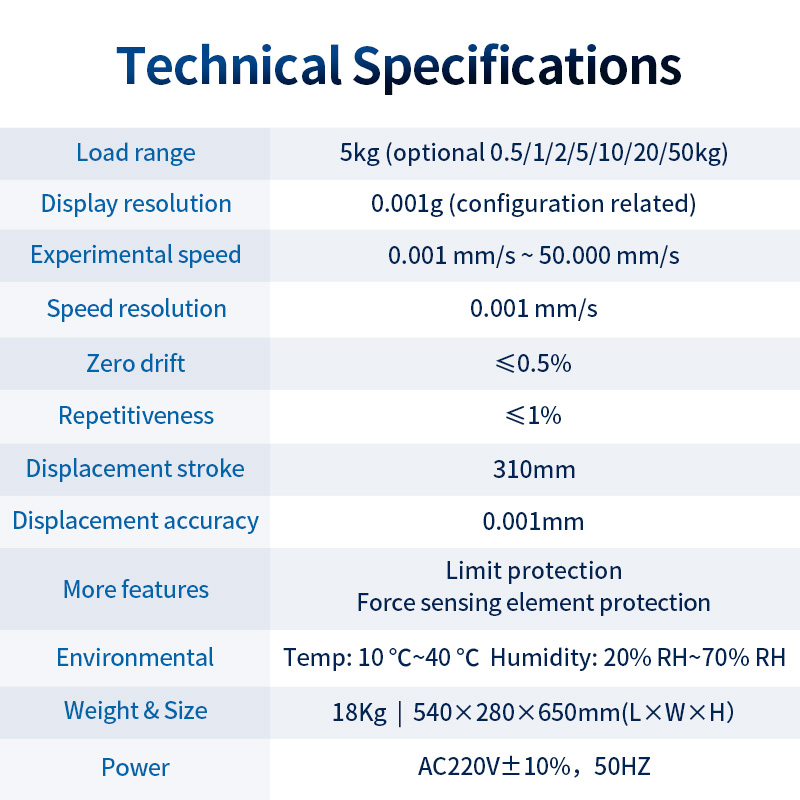
| Load capacity | Standard 5 kg (optional 0.5 kg, 1 kg, 2 kg, 5 kg, 10 kg, 20 kg, 50 kg) | |
| Force display resolution | 0.001 g (depending on configuration) | |
| Test speed | 0.001 mm/s~50.000 mm/s | |
| Speed resolution | 0.001 mm/s | |
| Zero drift | ≤0.5% | |
| Repeatability | ≤1% | |
| Displacement stroke | 310 mm | |
| Nominal displacement index | 0.001 mm | |
| Display | 7-inch HD touch screen | |
| Data storage | Up to about 5,000 reports (depending on report content) | |
| Communication interface | USB | |
| Operating language | Chinese and English switchable | |
| Height calibration | Provided | |
| Limit protection | Provided | |
| Force sensor protection | Provided | |
| Environmental requirements | Temperature: 10℃~40℃; humidity: 20%RH~70%RH (non-condensing) | |
| Weight | Approx. 18 kg | |
| Dimensions | 540 mm×280 mm×650 mm (L×W×H) | |
| Power supply | AC 220 V±10%, 50 Hz | |
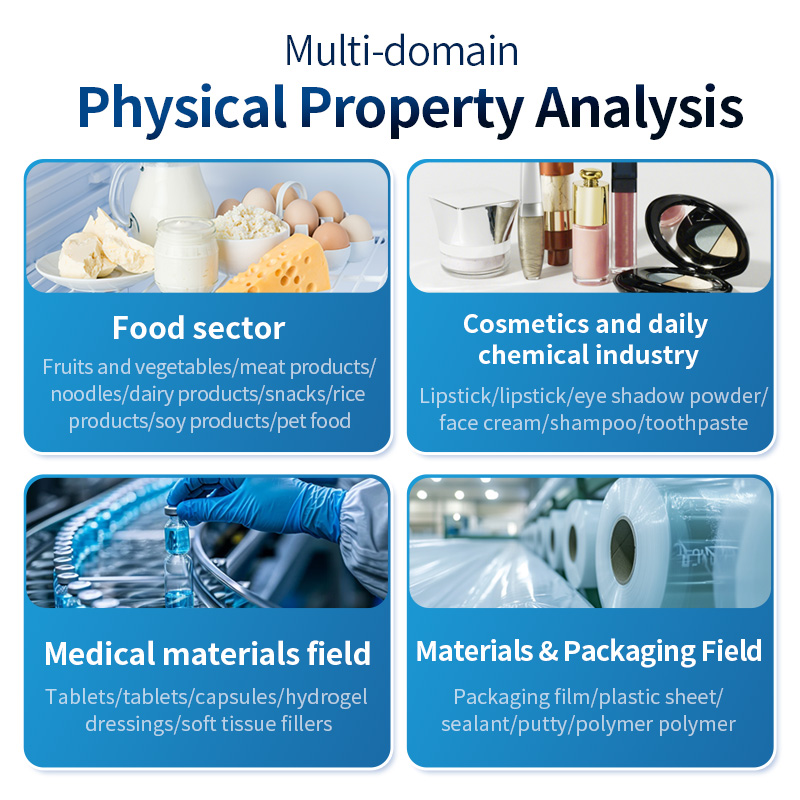
1. Food field
| Object category | Examples of specific samples | Core test items |
|---|---|---|
| Fruits and vegetables | Whole fruits (apple, pear), leafy vegetables, tubers | Skin hardness (maturity, freshness), puncture strength (flesh texture), shear force (firmness, crispness), compression characteristics (storage and transport resistance), tear strength (leafy vegetables) |
| Meat products | Fresh meat, ham, sausage, fish balls, minced meat | Tenderness/shear force, springiness (fish balls, meat balls), gel strength (minced meat products), TPA indicators (hardness, chewiness, resilience) |
| Flour products | Bread, cake, noodles, raw/cooked dough, biscuits | Hardness/softness, springiness/chewiness, tensile strength/extensibility, adhesiveness, brittleness/breaking strength |
| Dairy products | Cheese, butter, yogurt, ice cream, cream | Hardness/firmness, adhesiveness/spreadability, consistency, extrudability and melt resistance evaluation |
| Snack foods | Biscuits, potato chips, jelly, gummy candy, candy, puffed food | Brittleness/crispness, hardness, gel strength/springiness, adhesion response |
| Rice products | Cooked rice, rice cake, rice noodles, rice vermicelli, rice sheet | Hardness/stickiness, springiness/chewiness, tensile strength, shear strength |
| Soybean products | Tofu, dried tofu, yuba, vegetarian chicken, soybean sheet | Gel strength/springiness, puncture strength, shear strength, tensile/bursting strength |
| Pet food | Dry food, canned food, dental sticks, pudding, meat strips | Hardness, springiness, adhesiveness, brittleness/breaking strength and toughness |
2. Cosmetics and daily chemical field
| Object category | Examples of specific samples | Core test items |
|---|---|---|
| Color cosmetics | Lipstick, lip balm, eyeshadow pressed powder | Hardness, brittleness/breaking characteristics, powder compact firmness |
| Creams and lotions | Face cream, shampoo, toothpaste | Consistency, adhesiveness, extrudability and spreadability |
3. Pharmaceutical and medical material field
| Object category | Examples of specific samples | Core test items |
|---|---|---|
| Solid preparations | Tablets/lozenges, capsules | Breaking force/hardness, coating adhesion strength, capsule shell tensile strength |
| Medical gels | Hydrogel dressings, soft tissue filling materials | Gel strength, adhesion/tensile response, creep and stress relaxation |
4. Material and packaging field
| Object category | Examples of specific samples | Core test items |
|---|---|---|
| Soft materials | Packaging films, plastic sheets | Tear strength, bursting strength, tensile strength and puncture response |
| Viscoelastic materials | Sealant, putty, polymer | Creep/stress relaxation, adhesiveness, consistency and workability |

Products
Services
About
Contact
Copyright © Shandong Horde Electronic Technology Co., Ltd. All Rights Reserved.
Disclaimer: This website cannot identify the intellectual property rights of uploaded images or text. If there is any infringement, please notify us in a timely manner, and this website will review and delete it as soon as possible.
008619053605658




 Agricultural Testing
 Packaging Testing
 Water Quality Testing
 Physical Performance Testing
 Microbiological Testing
 Cleanliness Analysis
 Gas Detection
 Sample Pretreatment
 Spectral Analysis
 Laboratory Analysis
 Food Rapid Test
 Atmospheric Environment Analysis
 Biochemical Analysis
 Chromatography Analysis
 Hydrological Measurement
 Surveying & Mapping
 Other Specialized
 +86 19053605658
 WhatsApp

